
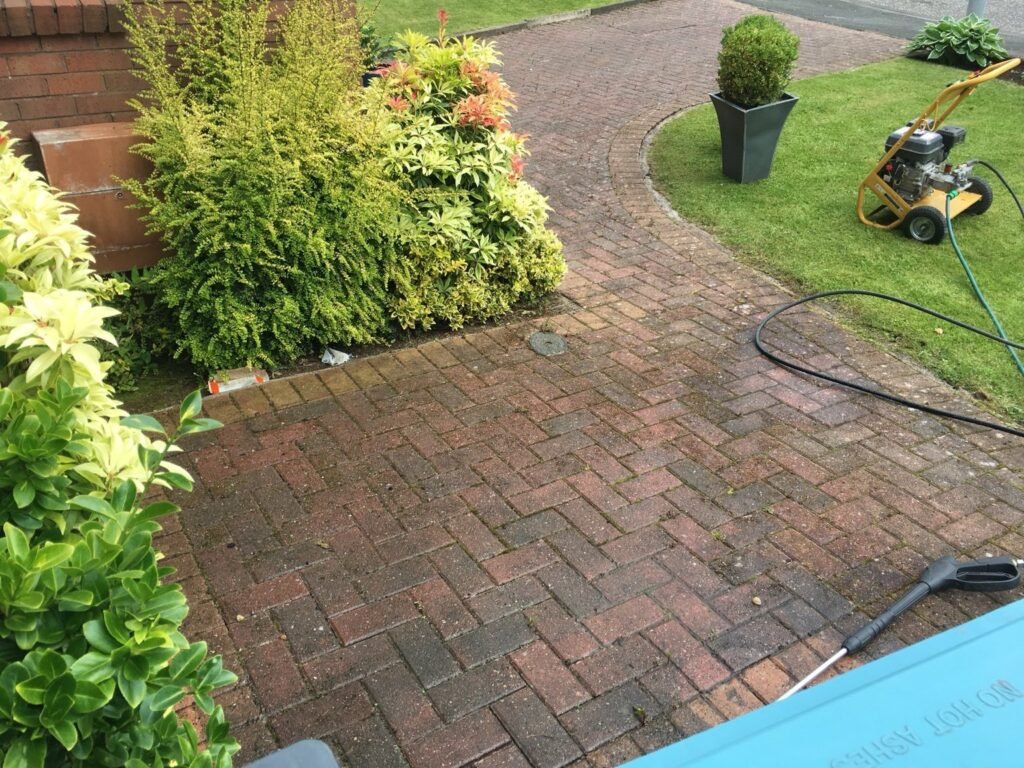
Half the driveways round here are monoblock. Every estate built since about 1990 has it, and it’s a good surface — it drains, it takes a car, and if one block cracks you replace one block.
It also goes green faster than anyone expects, and the reason isn’t dirt.
It’s algae, and it’s growing on the water
The black-green film that creeps across a monoblock drive isn’t muck that’s been walked in. It’s a living thing, and it’s living on moisture. Which is why the pattern is so predictable:
- The shaded side goes first. Along the house wall, under the hedge, behind the wheelie bins.
- The middle of the drive stays cleaner — sun gets to it, tyres scrub it.
- It arrives in autumn and looks worst in February. Not because winter is dirtier, but because nothing dries out between October and March.
If your drive has a clean strip where the car sits and green everywhere else, that’s not the car protecting the surface. That’s just the only bit that ever gets dry.
The joints are the real story
The sand between the blocks does more work than people realise. It locks the blocks together — that interlock is the whole point of the design. Blocks don’t hold each other up by weight; they hold each other up by friction through that sand.
Three things eat it:
Weeds. They root in the joint, and when you pull them out the sand comes with them.
Ants. Genuinely a problem here. They nest under the blocks and push sand up to the surface in little cones. Every cone is sand that used to be holding a joint together.
Aggressive washing. More on that in a second, because this is where people cause themselves real damage.
Once enough joint sand is gone, blocks start to rock under a wheel. Then one edge drops. Then you’ve got a dip that holds water, which grows more algae, which makes it worse.
Where people go wrong
Turning the pressure right up. It’s the obvious move and it’s the wrong one. A tight, high-pressure jet will strip algae, and it’ll strip every gram of jointing sand along with it — plus the fine surface layer of the block, which is what gives it colour. Drives that have been blasted hard look brilliant for a fortnight and then go blotchy and pale, because the surface is now rougher and holds dirt better than it did before.
You can usually spot a drive that’s been over-washed: pale, patchy, and it re-greens within months.
Bleach. It kills the green and it also runs off into your borders and your lawn. Neighbours’ lawns too, if the drive falls that way.
Skipping the re-sand. This is the big one. Cleaning a monoblock drive always removes some joint sand, even done gently. If nobody puts it back, you’ve made the drive look better and structurally worse in the same afternoon.
What actually works
Flat surface cleaner, not a lance. A rotating surface cleaner spreads the pressure evenly across the whole block instead of concentrating it in one line. Cleans better, does less damage, and doesn’t leave the stripey pattern you get from waving a lance about.
Sensible pressure. Enough to lift the algae, not enough to excavate the joints.
Kiln-dried sand back in, afterwards. Brushed in and settled. This is not optional and it is not an upsell — it’s part of doing the job properly.
Treatment where it’s needed. Algae comes back from what’s left behind. A proper treatment slows that down considerably.
How often?
Most drives round here look tired after two to three years, faster if they’re shaded or north-facing.
Doing it every year is a waste of your money and takes more out of the joints than the drive gets back. Doing it never means you eventually need blocks lifting and relaying, which is a different trade and a much bigger bill.
Two to three years is about right for most of Airdrie, Coatbridge and Motherwell.
What it costs
- From £100 for a typical two-car driveway
- Larger or badly gone-over drives quoted on site
- Kiln-dried sand included, not extra
I bring my own water, so nothing runs off your outside tap, and I keep well clear of render, paint and anything planted.
Worth knowing: if I’m already coming for the drive, doing the windows or gutters in the same visit costs you one trip-out instead of two. That’s usually where the saving is.
The honest version
A clean drive is the single biggest difference you can make to how a house looks from the pavement — more than the windows, more than the door. If you’re selling, it’s the cheapest thing on the list that people actually notice.
If you’re not selling and it’s only a bit green in the shady corner, it can wait a year. I’ll tell you that if that’s what I find.
Send me a photo and your postcode and I’ll give you a price the same day. One person, one visit, one bill — and it’ll be me who turns up.