
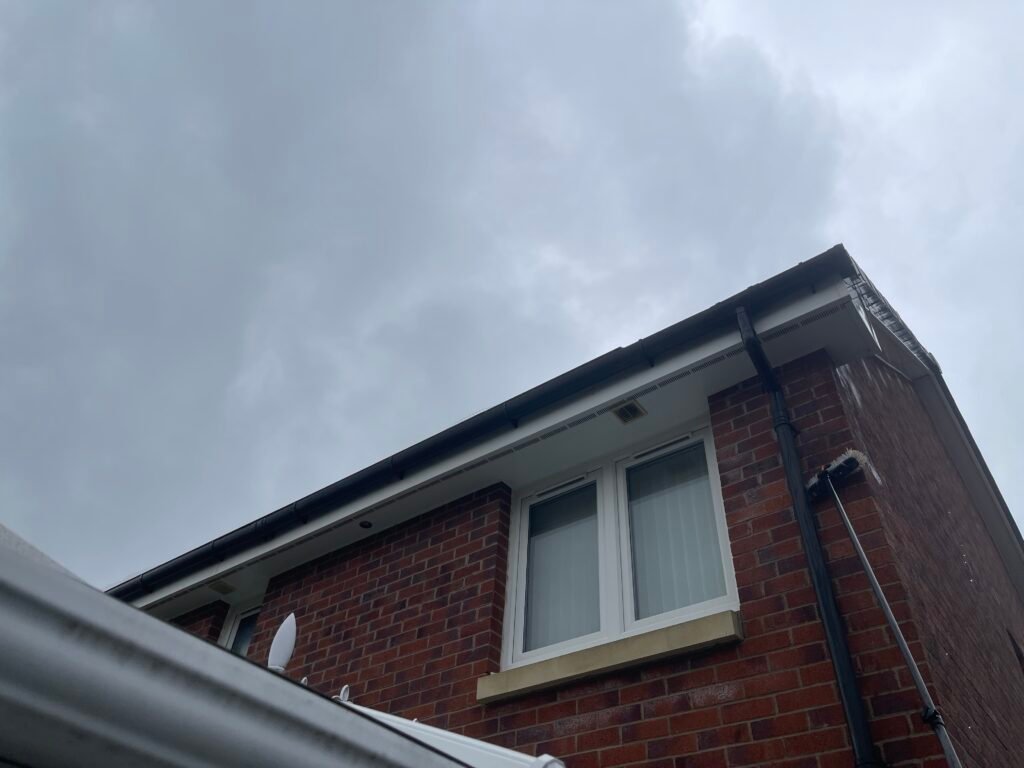
Most people ring me and say “the white bits under the roof are filthy.”
That’s a perfectly good description and I know exactly what they mean. But if you want to understand a quote, or work out whether what you’re looking at is dirt or damage, it helps to know which bit is which. There are only four of them and it takes two minutes.
The four parts, from the top down
The fascia is the long board that runs horizontally along the bottom edge of the roof. It’s the one your gutter is screwed to. It’s doing real structural work — it carries the weight of a full gutter, and in Lanarkshire a full gutter is heavy.
The soffit is the board underneath, tucked in between the fascia and the wall. You only see it if you stand under it and look up. It closes off the gap between the roof and the wall, and on most houses round here it’s vented.
The bargeboard is the sloped one. On a gable end, where the roof forms a triangle, the boards running up the diagonal are bargeboards. Same material, same job, but sloped instead of level — and no gutter attached.
The box end is the small corner piece where the fascia stops and the bargeboard begins. It’s about the size of a paperback. It’s also where nearly every leak and every stubborn green stain starts, because water going round that corner slows down and sits.
Why it matters when you’re getting a price
Two houses, same street, same size, different quotes. Usually one of these is why:
- Bungalows have more of it than you’d think. A long, low roofline can have more metres of fascia than a two-storey semi.
- Gables add bargeboard. A detached house with two gable ends has a lot of sloped board that a mid-terrace simply doesn’t have.
- Height changes access, not just difficulty. Anything above two storeys needs different kit.
So when I quote, I’m counting metres and looking at what’s reachable — not guessing from the postcode. That’s why I ask for a photo from the pavement before giving a number.
What the green stuff actually is
The dark green streaks running down white UPVC are algae. Not mould, not dirt, and not something you’ve done wrong.
Algae lives on moisture and it doesn’t need soil. Scotland gives it rain spread thin across the whole year rather than dumped in storms, which means the boards rarely get a proper dry spell. North-facing elevations go first and stay worst.
Two things make it worse on a specific house:
- An overflowing gutter. Water running over the front lip keeps the fascia permanently wet. If one section is far greener than the rest, look directly above it.
- A leaking joint. Gutter joints fail quietly. You get a narrow, dark stripe rather than an even film.
That second one matters, because cleaning the board without fixing the joint means it’s back in a year. I’d rather tell you on the day than take the money twice.
The bit nobody looks at
The soffit is the one people forget, because you have to be standing underneath and looking up.
It’s also the one with the vents in it. Those slots or round grilles let air move through your loft, which is what stops condensation forming on the underside of the roof in winter. Block them — with algae, moss shed from the roof, or a nest — and you get damp in the loft that looks for all the world like a roof leak.
If you’ve ever had a “roof leak” that nobody could find, it’s worth having someone look at the soffit vents.
Cleaning versus replacing
You’ll get quotes to replace all of it. Sometimes that’s right. Often it isn’t.
Cleaning is right when the board is sound, the discolouration is on the surface, and there’s no softness or splitting. That’s the overwhelming majority of UPVC I see. UPVC doesn’t rot — it just gets covered in something that does.
Replacing is right when the board is timber and gone soft, when UPVC has cracked in a way that lets water behind it, or when the fascia can no longer hold the gutter securely.
The honest test is to press it. Sound board resists. If someone quotes you thousands to replace UPVC that presses hard and looks solid, get a second opinion.
How I clean it
Soft brush and a biodegradable cleaner, worked along the board, then rinsed with pure water.
No pressure washer. A pressure washer will drive water up behind the fascia and into the roof space, and on older UPVC it can leave the surface microscopically rough — which means it holds dirt faster afterwards than it did before. It looks brilliant for one summer and worse every year after.
I work from the ground with a pole system where I can, so no ladder leans on your gutter and nothing gets bent while it’s being cleaned.
What it costs
- Fascia and soffit from £80 for a typical semi
- Larger detached with gables quoted after I’ve seen a photo
- Gutter clearing from £25 per side — worth doing at the same visit, because whatever comes off the boards ends up in the gutter anyway
One trip, one price, one bill. I’ve been doing this round Airdrie, Coatbridge, Motherwell and Cumbernauld since 2016, and it’ll be me at your door — not whoever the rota sent.
Send a photo from the pavement and your postcode and I’ll come back the same day. 07440347383
Still not sure which bit is which?
What is the difference between a fascia and a soffit?
The fascia is the upright board you see from the street, running along the edge of the roof with the gutter screwed to it. The soffit is the flat one tucked underneath it, the bit you only see if you stand close and look up. Fascia faces out, soffit faces down.
Where does the bargeboard come into it?
The bargeboard is the sloping one that runs up the gable end, following the line of the roof. It is doing the same job as a fascia but on the angled edge, and it is the part people forget to mention when they ring for a price.
Does it matter which one I name when I ask for a quote?
It helps, but do not lose sleep over it. Send a photo from the pavement and I will work out what I am looking at. Getting it right matters more for the price than for the conversation, because a house with long bargeboards is more work than one without.
Can these boards be cleaned rather than replaced?
Far more often than people are told. Boards that look beyond saving are usually just carrying years of algae. Replacement is a joiner and a serious bill; cleaning starts at £80 with a 12-month guarantee. If a board genuinely is rotten I will say so rather than wash it and take the money.
Why the boards matter beyond looks. Historic Environment Scotland’s building conservation centre describes the job of the whole system as “carrying water away from a building to prevent it from entering the fabric or running down the walls”. The fascia is what the gutter is fixed to, so when it softens, the system stops doing that (Engine Shed, rainwater goods).
Getting a price
Send a photo from the pavement and your postcode. Same-day response on quotes, usually within a few hours. Call or text 07440347383.