
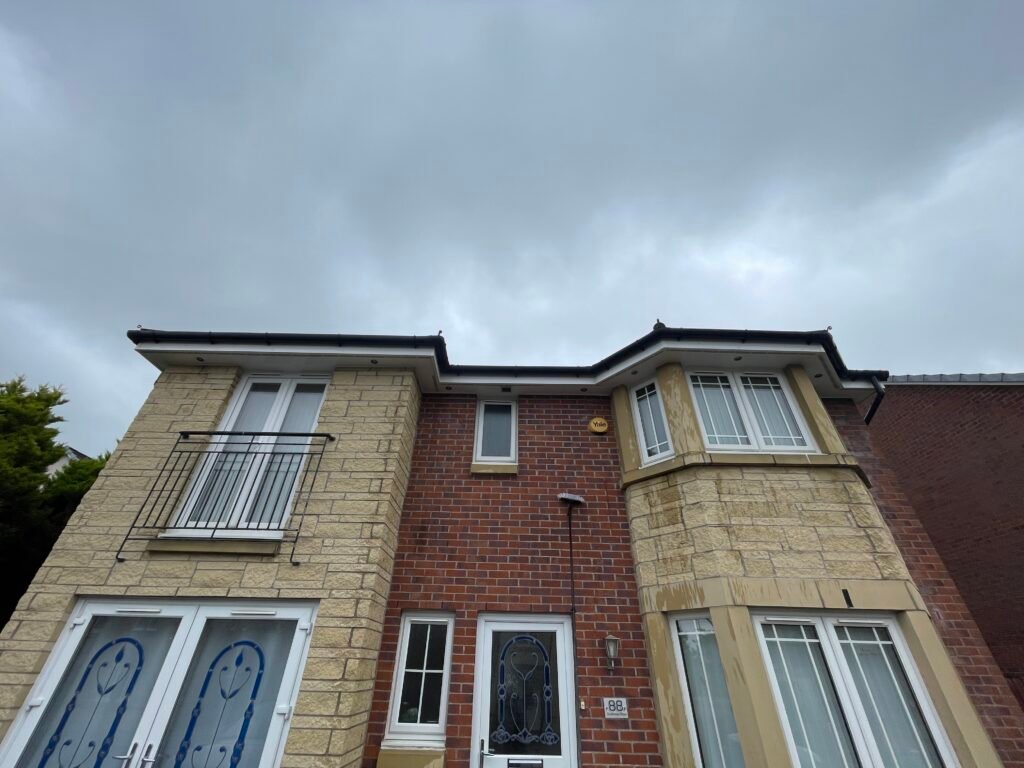
You do not need to get up a ladder to know whether your gutters are blocked. Every one of these is visible from the ground, and I have listed them roughly in order of how urgent they are.
1. Water pouring over the front edge in heavy rain
The obvious one, and the only one most people know about.
A working gutter takes water to the downpipe. If it is coming over the front lip instead, the run is full enough that water has nowhere else to go.
Worth watching where it comes over. One spot means a local blockage or a sag. Along the whole run means the whole thing is packed.
2. A dry downpipe during a downpour
This is the sign almost nobody checks, and it is the most useful one on the list.
Stand outside in proper rain and look at the bottom of the downpipe. If the gutter is overflowing above and no water is coming out the bottom of the pipe, the blockage is in the downpipe or at the outlet — not spread along the gutter.
That matters because it changes the urgency. A gutter that is generally full is a job for spring. A blocked downpipe means every drop of water hitting that roof slope is going down your wall instead, and that does not wait.
Thirty seconds, no ladder, and it tells you more than looking at the gutter does.
3. Green along the gutter line — or actual grass
Look up at the gutter from across the road.
A green fringe along the top edge means organic matter has been sitting in there long enough to grow. Actual grass or a small fern means it has been months, possibly years.
Round here that material is usually moss off the roof, not leaves. It sheds all winter, packs down, holds water, and eventually germinates whatever seed lands in it. If you have grass in the gutter, it is worth looking at the roof too, because that is where it came from and it will do it again.
4. A stain running down the wall
A vertical dirty streak on the render or brickwork below one particular point on the gutter.
That is where water has been coming over, repeatedly, for a long time. The stain is the evidence that this has been happening in every heavy rain, not just once.
On pebbledash and render it soaks in rather than running off, which is how you get a damp problem inside from a gutter problem outside.
5. Fascia board gone soft, dark or peeling
The fascia is the board the gutter is screwed to. If the gutter overflows at the back edge rather than the front — which happens when the run has sagged — the water goes straight down the back of the gutter onto that board and stays there.
Signs: discolouration, paint lifting, the board looking swollen, or a section that has gone visibly darker than the rest.
This is the point where a cleaning job starts turning into a joinery job. Catching it here is much cheaper than catching it later.
6. A damp patch inside that nobody can explain
An unexplained damp mark on an upstairs internal wall, often near the ceiling and often only appearing after heavy rain.
People chase this one for months — checking the roof, blaming condensation, repainting — and it is very often a gutter. Water coming over the back edge tracks along the wall plate and comes through some distance from where it started, which is why the connection is not obvious.
If you have this and you also have any of signs 1 to 5, look at the gutter before you spend money on anything else.
Questions people ask about blocked gutters
Which of these signs means I should ring today?
A damp patch inside, or a stain running down the outside wall. Both mean water has been going somewhere it should not for a while. Water pouring over the front edge in heavy rain is worth sorting, but it will keep a week or two.
Is grass actually growing in my gutter a problem?
Yes, and more than people think. Grass means there is enough packed silt in there to act as soil, which is well past the leaf stage. That is the point where the gutter is carrying real weight and the brackets start to suffer.
Will a blocked gutter wreck the fascia board?
Given long enough, yes. Water sitting behind a full gutter soaks the board until it goes soft and dark. Clearing is from £25 per side; replacing a run of fascia is a joiner and a much bigger bill. Fascia and soffit cleaning starts at £80 with a 12-month guarantee.
How much does it cost to clear a blocked gutter in Airdrie?
From £25 per side. Most houses here need two sides doing, so a typical job starts at £50, and a detached with four runs starts at £100. Fixed price agreed before I start.
Why these signs matter. Historic Environment Scotland’s building conservation centre describes the chain in one line: “Blockages lead to water overflowing and leaking into the building through the roof or walls.” Every sign on the list above is that process caught at a different stage (Engine Shed, rainwater goods).
Getting a price
Which of these can wait
Cannot wait: the dry downpipe (2), and the damp patch inside (6).
Should be done this season: the wall stain (4) and the fascia damage (5) — the damage is already happening and it gets more expensive.
Can wait for spring: overflowing along the whole run (1) and the green fringe (3), assuming nothing else on the list applies. March or April is the right time anyway, because that is when the winter’s worth of moss has finished coming down.
If you are not sure
Send me a photo of the gutter line taken from the pavement, plus your postcode. You will get a straight answer back the same day — including “that is fine, leave it”, which is the answer more often than people expect.
07440347383
More: what it costs · how often it needs doing · after a storm