
Once a year for most houses. Twice if you have trees within about ten metres.
That is the whole answer. The rest of this is how to tell which one you are, and why the timing advice you will read everywhere else is written for a different country.
Spring, not autumn — and this genuinely matters here
Every gutter guide online says the same thing: clean them in autumn, after the leaves come down.
That is English advice. It does not describe what happens to gutters in North Lanarkshire.
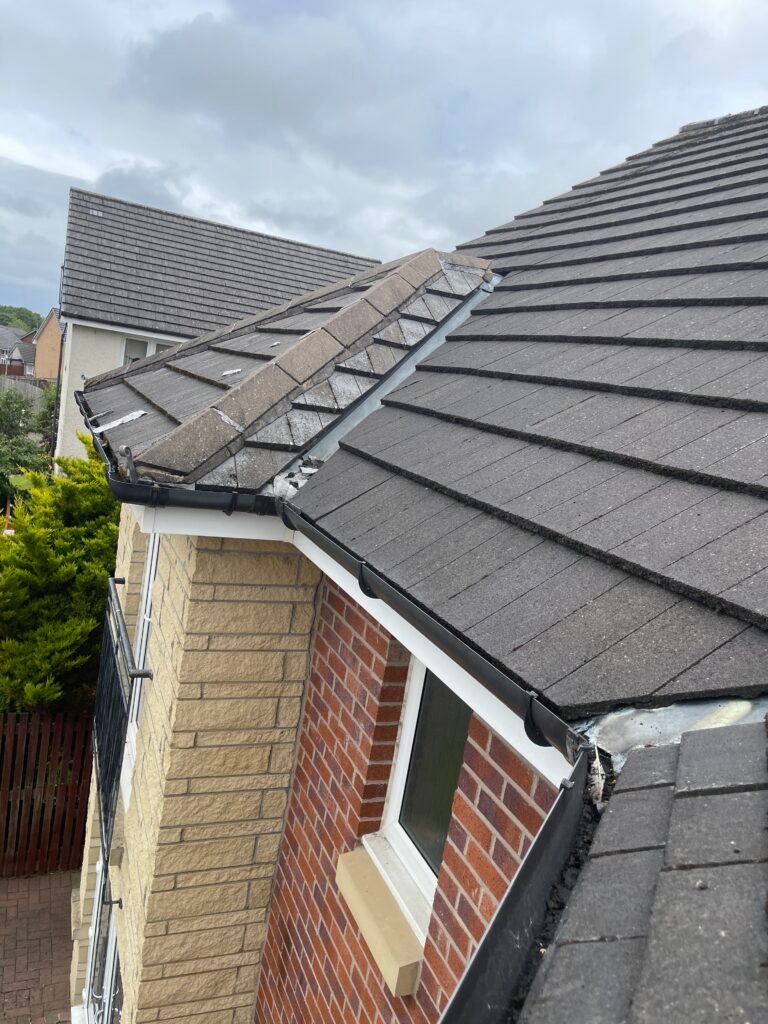
What actually fills gutters round here is moss off the roof and grit off the render, shedding all winter and packing down into the run. It is not dramatic and you cannot see it happening. It just compacts, month after month, until the gutter is holding a solid strip of it.
What you can see is March. The light comes back, you look up, and there is grass growing out of your gutter line.
Grass in the gutter is not a curiosity. It means there has been enough packed organic matter up there, wet, for long enough to germinate seed. It has been full for months.
That is why spring is my busiest stretch and why I would put your annual clean in March or April rather than October, if you are only doing one.
When the second clean makes sense
Add an autumn one — late October to mid November — if you have trees close by.
The timing is narrower than people think. Leaves round here fall into November. Clear in September and the gutter fills again before the winter rain arrives, and you have paid for nothing. Wait until the trees are mostly down.
No trees near you? Then once a year in spring is plenty and you can skip the autumn one entirely. I would rather tell you that than sell you a second visit.
What decides it for your house
Trees within ten metres. The big one. Not just your own — next door’s sycamore does not respect the fence.
Which way the roof faces. North-facing slopes hold moss because they never properly dry out. If your roof looks green on one side and not the other, the green side is feeding your gutter.
Roof surface. Concrete tiles hold moss far more readily than slate. Older concrete tiles that have started to go porous are the worst of the lot.
Exposure. Higher, more open streets get more wind-blown grit and lose more surface off the render.
Whether anyone has ever done it. If the answer is “not since we moved in”, the first one is a proper job regardless of everything above.
The thirty-second test
You do not have to guess and you do not need a ladder.
Wait for proper rain. Go out and look at the downpipe.
- Water gushing out the bottom of the downpipe — gutter is running. Fine.
- Water pouring over the front edge of the gutter while the downpipe stays dry — the blockage is in the downpipe or the outlet, not spread along the run. That one does not wait for spring.
- Water dripping steadily from the same spot in dry weather — that is a joint, not a blockage, and it is a repair rather than a clean.
What “left too long” looks like
- Grass or a visible green fringe along the gutter line
- Staining running down the wall below one particular spot
- Fascia board behind the gutter gone soft or discoloured
- A damp patch on an upstairs interior wall that nobody can explain
The last one is the expensive one. By the time water has come through the wall, the cost is a joiner and a plasterer, not a cleaner.
Once a year, honestly, is enough for most people
I am not going to tell you gutters need quarterly attention. They do not. For a typical semi in Airdrie with nothing overhanging it, one visit in spring keeps it right, and the money is better spent on the fascias at the same time — they sit directly under the gutter and they are what people actually notice from the street.
Common questions about gutter timing
How often should gutters be cleaned in Airdrie?
Once a year suits most houses here, and spring is the right time for it. Twice a year if you have mature trees within about ten metres of the roof. Clearing is from £25 per side, so a typical two-sided semi starts at £50.
Is spring or autumn better for gutter cleaning in Scotland?
Spring. An autumn clear gets the leaves but leaves the winter silt and moss sitting in the gutter for months afterwards. By March you can usually see green along the line from the pavement, and that is the point where it is doing damage rather than just looking untidy.
Can I leave the gutters if nothing is overflowing?
Often, yes. If nothing overhangs the roof and the water runs away properly in heavy rain, you may not need me this year. Send a photo from the pavement and I will tell you straight whether it needs doing.
Do you clear gutters by hand or with a vacuum?
By hand, so the compacted silt and moss come out rather than just the loose leaves on top. Where a roof is too high or the access is too tight for a ladder to be safe, I use vacuum poles from the ground instead. Same price either way.
Once a year is not a sales figure. Historic Environment Scotland’s building conservation centre says the same thing about any building with gutters on it: “You should inspect rainwater goods every year.” That is inspect, not necessarily clear — which is exactly why I will tell you when the answer is “not this year” (Engine Shed, rainwater goods).
Getting a price
Not sure which category your house is in? Send me a photo of the gutter line from the pavement and your postcode. I will tell you whether it needs doing this year.
07440347383
More: what it costs · the warning signs · after a storm