
It’s the question I get asked most about driveways and patios, and it’s a fair one. Everybody has seen a clip of someone carving their name into a slab with a lance.
Short answer: yes, if the person holding it knows what they’re standing on. The damage people are afraid of is real, but it comes from using one pressure and one nozzle on every surface, which is what happens when someone hires a machine for a Saturday.
Here’s what’s actually safe, what isn’t, and what to ask before you let anyone start.
It depends entirely on the surface
Round here you’ll have one of five things underfoot, and they behave completely differently.
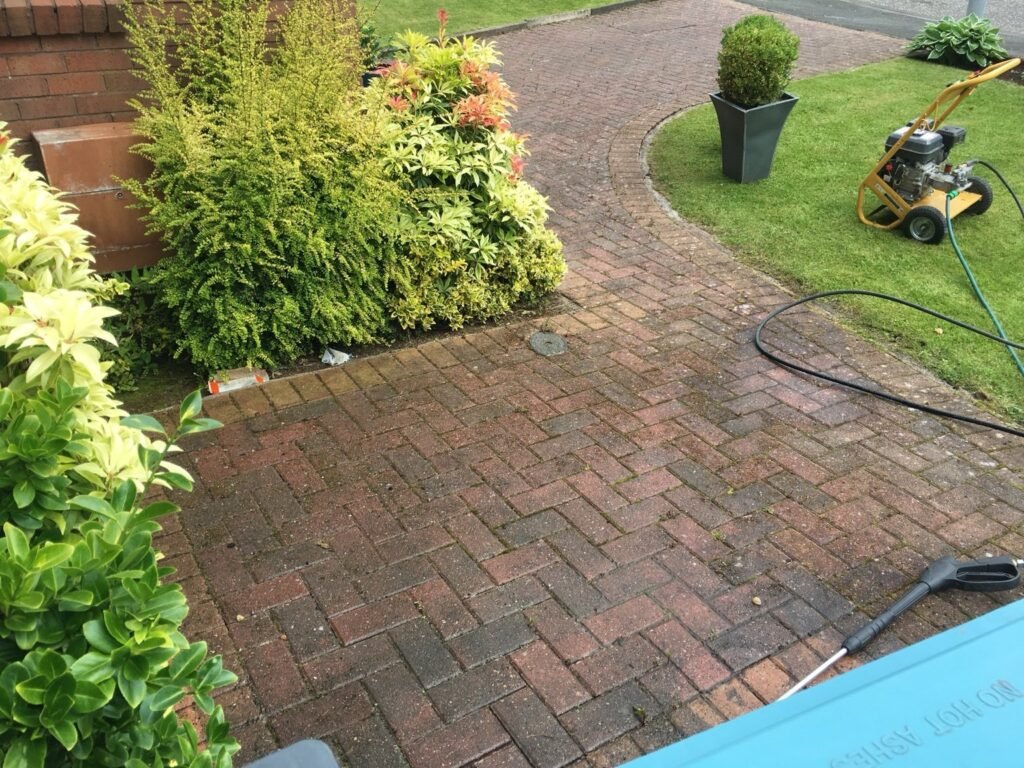
Monoblock. The most common driveway in North Lanarkshire and the most forgiving. The blocks themselves are dense and take pressure well. The vulnerable bit isn’t the block, it’s the sand in the joints — more on that below.
Concrete flags and imprinted concrete. Tough, but imprinted concrete usually has a sealer on it. Hit that too hard and you take the sealer off in patches, which looks worse than the algae did. It needs resealing afterwards, and that’s a separate job I’ll tell you about before, not after.
Indian sandstone. Very common on patios laid in the last fifteen years, and much softer than people assume. Too much pressure lifts the surface and leaves it permanently rougher — which then holds dirt better than it did before. Low pressure and patience, or don’t touch it.
Old concrete slabs. The 1970s grey ones. Usually fine, but if they’ve started to spall — that pitted, crumbly look — pressure will accelerate it. Cleaning won’t cause the problem; it will finish what frost started.
Decking and timber. Softest of the lot. Wrong nozzle and you raise the grain into splinters.
If someone quotes you the same way for all five, that tells you something.
The joints are the real risk, not the surface
This is the part almost nobody mentions, and it’s the part that actually costs money.
Monoblock is held together by kiln-dried sand in the joints. That sand is structural. It locks the blocks against each other so they spread the weight of a car instead of each taking it alone.
Any wash takes some of that sand out. That’s unavoidable — it’s sand and you’re using water.
What matters is what happens next. If the sand isn’t put back, over the following winter the blocks start to move independently, the edges chip, and you get the sunken tyre tracks you see on driveways that were cleaned once and never touched again. People blame the cleaning. It wasn’t the cleaning, it was the not-refilling.
So: brushing kiln-dried sand back into the joints is part of the job, not an extra. If a quote doesn’t mention it, ask. If the answer is vague, get another quote.
What too much pressure actually looks like
You don’t need to guess. The signs are visible on the day:
- Stripes. Light and dark bands where the lance moved unevenly. That’s surface removal, not cleaning, and it doesn’t grow back.
- A furry, pale finish on sandstone. The surface has been opened up.
- Mortar washed out of the joints on a flagged patio, leaving little trenches.
- Sand piled at the bottom of the drive and nothing put back.
A properly done job looks even. Boring, in a good way.
What I do differently
Rotary surface cleaner, not a lance, on flat areas. It’s the flat disc thing on wheels. It keeps the nozzle a fixed distance from the surface and moves at a constant rate, so you get an even result instead of stripes. The lance only comes out for edges and corners.
Pressure matched to the surface, dropped right down for sandstone and timber.
Sand back in afterwards on every monoblock job, brushed in and settled.
Water controlled, not just fired everywhere. Your neighbours’ cars and your own render aren’t part of the job.
I’ll tell you when not to. If a patio is already failing — mortar gone, slabs rocking, spalled concrete — cleaning it makes the failure obvious rather than fixing it. I’d rather say that than take your money and hand you a worse-looking patio.
The autumn argument
October is the best month of the year for this round here, and it’s not about looks.
Wet leaves sit on paving for weeks, and what’s underneath them goes properly slippery — not a bit slidey, but the sort of slippery that catches people out on a dark morning going to the car. Algae plus a wet leaf mat on smooth concrete is genuinely hazardous.
Clearing it in October buys you the whole winter. Doing it in April means you’ve already had the risky months.
What it costs
- From £100 for a typical two-car off-street driveway.
- Patios, paths and steps priced the same way — by area, condition and access.
- Kiln-dried sand included on monoblock. Not an add-on.
- Sealing, if the surface needs it, quoted separately so you can see what you’re paying for.
If I’m already at yours for the gutters or the windows, adding the drive costs you one trip-out instead of two. That’s usually where the saving is.
Before you book anyone
Four questions. The answers tell you everything:
- What pressure will you use on my surface, and why that one?
- Do you use a surface cleaner or just a lance?
- Is kiln-dried sand going back in, and is it in the price?
- What will you do if you find something underneath that’s already broken?
Send me a photo of the drive or patio and your postcode and I’ll give you a straight answer, including that doesn’t need doing yet if that’s what I think.
07440347383