
Every winter I get called to a house where somebody has had two roofers up, replaced a few tiles, resealed a flashing, and still has damp in the loft.
Often there was never a leak. The roof is fine. The problem is six inches lower down, in the vents along the underside of the soffit — and it shows up in exactly the same way.
What the vents are for
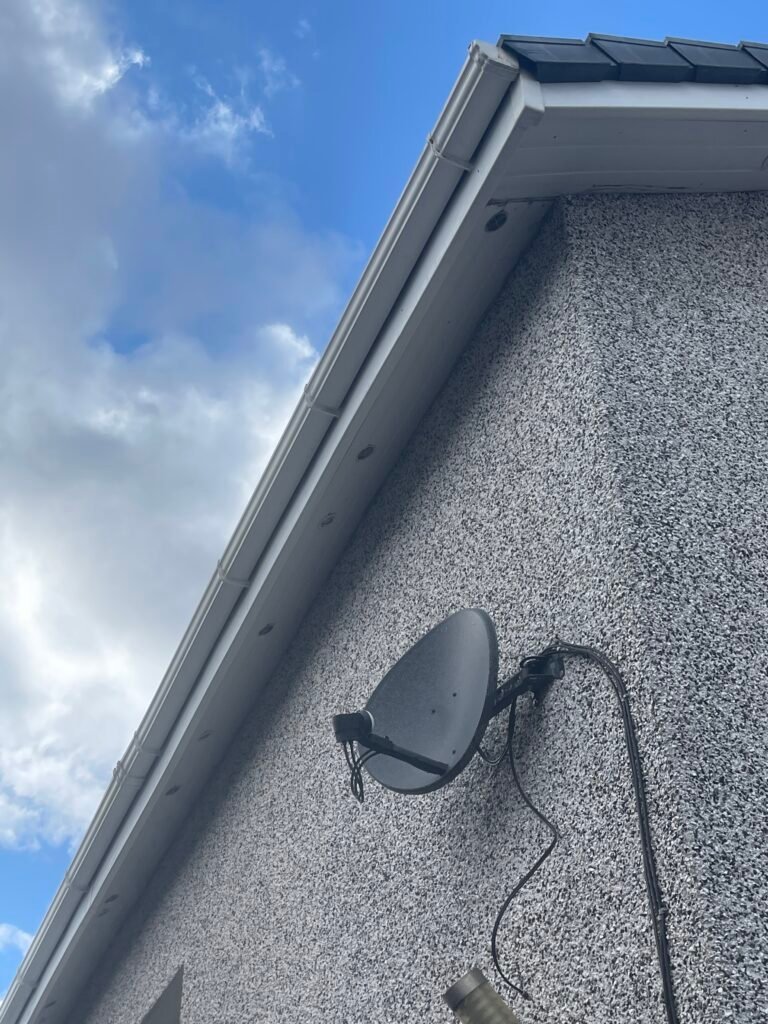
Stand under your eaves and look up at the board tucked between the wall and the gutter. That’s the soffit. On most houses built or refurbished in the last forty years it has ventilation in it — either a continuous slot, a strip of small holes, or round push-in grilles.
They’re not decorative and they’re not optional. They let outside air move into the loft at the eaves, across the underside of the roof, and out at the ridge. That airflow is the only thing keeping your loft dry in winter.
Why a dry loft needs moving air
A household puts a surprising amount of water into the air — showers, cooking, drying clothes on a rack, breathing. Warm, damp air rises, and some of it always finds its way into the loft.
In the loft it meets the underside of the roof, which in a Scottish January is very cold. Warm damp air plus cold surface equals condensation. That’s not a fault; it’s physics, and every house does it.
The ventilation is what carries that moisture back out. Block the vents and it has nowhere to go. It condenses on the felt and the timbers, runs down, and drips onto the insulation — which looks, feels and stains exactly like a leak.
Telling condensation from a leak
Four things separate them, and you can check all four from the loft hatch with a torch.
Where it is. A leak is local — one spot, under one specific defect. Condensation is spread out, usually worst near the eaves and on the coldest slope, which round here is the north side.
When it happens. A leak appears during or just after rain. Condensation appears on cold, still nights and is worst first thing in the morning — often with no rain at all. That’s the clearest single test.
What it looks like. A leak stains: brown tidemarks, defined edges. Condensation gives fine droplets over a wide area, sometimes frost on the nail points in a cold snap.
Whether it moves. A leak comes back in the same place every time. Condensation shifts with the weather.
If your damp is worst on a dry, frosty morning, stop looking for a hole in your roof.
What blocks the vents
- Algae and general grime. The same green film that discolours the fascia grows across vent slots and gradually closes them. Commonest cause here, and the easiest to fix.
- Roof moss. Sheds off concrete tiles, washes down, and packs into the vent holes from above.
- Insulation pushed too far. Very common after a loft top-up — someone rolls it right out to the eaves and blocks the airflow path from the inside.
- Nests. Birds and wasps like a sheltered vent. Usually spring.
What it costs you if it’s left
- Damp insulation — and wet insulation stops insulating, so your heating bill rises
- Mould on the timbers
- Rot in the roof timbers, which is a proper repair rather than a clean
The first two are reversible. The third isn’t, and it’s the reason I bother mentioning any of this.
The five-minute check you can do
From outside: stand under the eaves and look up. Can you see through the vent slots, or are they closed over with green film? Check the north side and the shaded elevations first.
From inside: loft hatch, torch, look towards the eaves. You should see daylight at the edges in at least a few places, and there should be a gap between the top of the wall and the insulation.
On a cold morning: look at the underside of the roof before the day warms up. Droplets or frost on the nail tips means ventilation, not a leak.
How I clear them
Soft brush and biodegradable cleaner along the soffit, working the vents specifically rather than just wiping the flat board, then rinsed with pure water. From the ground with a pole, so nothing leans on your gutter.
No pressure washer near a vent. Ever. The whole point of a vent is that it’s a hole into your roof space, and forcing water through it puts the water exactly where you’ve spent all this effort trying not to have it.
Gutters and roof first if they need it, because moss coming off the roof lands in the gutter and on the soffit. Clearing the vents while the source is still shedding is money you’ll spend twice.
What it costs
- Fascia and soffit from £80, vents cleared as part of it, not as an extra
- Gutter clearing from £25 per side if it’s needed at the same visit
- One trip, one price
If you’ve got damp in the loft and nobody can find the leak, send me a photo of your eaves and your postcode. If it turns out to be a genuine roof defect I’ll tell you that too — it isn’t my trade and I’m not going to pretend otherwise. 07440347383